
💪 The Engineering Behind Getting Huge 🏋
Casting, Cables and Getting Swol

⚙️ Mechanical Engineering Resources:
We have put a dozen guides for mechanical engineering students and early professionals on our website
50 Hardware Startups who have raised less than $50 million (perfect internship targets)
How to handle The Behavioral Interview
What it takes to be The 10X Intern
🦸 Guest Writer: Madhav!
This week’s newsletter is a special edition written by Madhav Bhat! Madhav graduated from the University of Michigan with a BSE and MSE May of 2024. Throughout his recruiting journey he interviewed for mechanical engineering internships and full-time positions with companies from large Fortune 500 corporations (think Ford, Michelin, Apple) to growth-stage companies (think Tesla, SpaceX, Anduril) to startups ranging from 3-1000 people in size working on all sorts of projects.
The other day I was at the gym (humble brag) and while I was doing lat pulldown I was looking down at the knee pads and noticed how crappy the welds were on it. Not that I could do much better and I am by no means a welding expert, but it got me started on thinking how are these weightlifting machines actually made? What level of calibration goes to making sure the weights are exact? It’s one of the simplest mechanical engineering problems but there has to be more under the hood. I also started thinking about Tonal and digital weight - how does that work? How exact is it? Here is my deep dive to hopefully answer that.
Traditional weightlifting machines
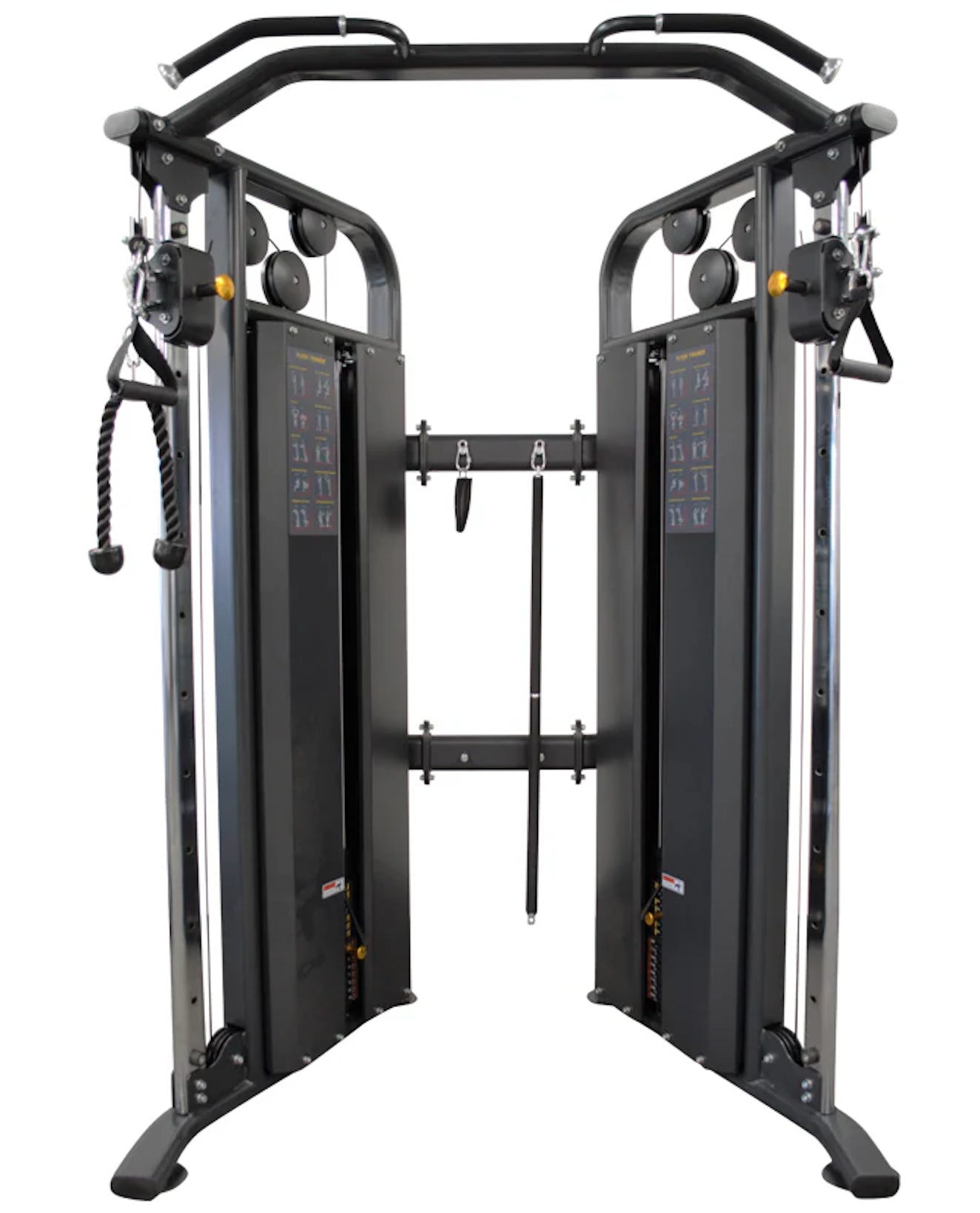
How they work is pretty simple: you have weight on one side attached to a cable, goes over a pulley, to whatever lifting attachment you have on the other side. One thing you might have noticed is “why doesn’t 85 lb at my gym feel the same as 85 lb at this other gym.” Well, there are actually a couple of pretty legit reasons! The first is cable routing; your local gym might have a 1:1 pulley system whereas your new gym has a 1:2 ratio machine. Very different. Also if you want to nit-pick, friction from the pulleys and wear on the cables can also change the amount of resistance you feel. I am not sure why I never processed this and just accepted that some gyms I’m king of the world and some I’m sickly.
Jiga
Source custom parts with direct access to the manufacturers making them. No middleman, no black box. Jiga gives you a vetted network and one accountable partner standing behind every order. You know who’s building your parts and communicate with them directly. AI-assisted operations handle supplier matching, quoting, quality verification, and production tracking, so the relationships stay human while the operations run at speed.

Going down to the weight level, it’s a very traditional casting process to make these weights. Standard gym plates start as gray cast iron. A pattern defines the mold shape, sand is mixed with a binder and packed into a flask around that pattern to create the mold cavity. Cores form any internal features, the mold halves are closed, and molten iron around 1,400°C is poured in. After cooling, the casting is broken out, cleaned of sand, has its gates and risers ground off, and gets painted or powder coated.
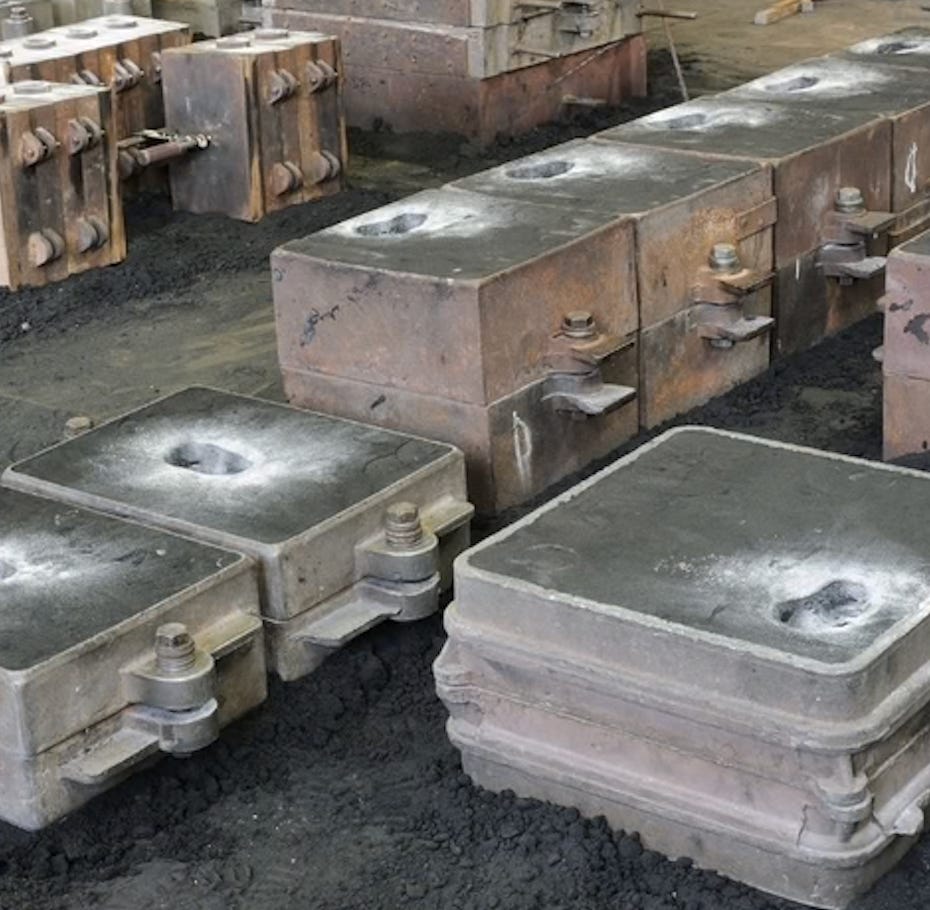
Sand casting is dimensionally sloppy, which is why cheap plates frequently miss their stated weight (that’s right just go ahead and round that 220 to a 225 and blame your Planet Fitness membership). Sand casting achieves only tolerance grades of roughly CT9 to CT13 (see: casting tolerances), loose by machining standards, and shrinkage and porosity vary pour to pour. This is also why a bargain bin 45 can be off by a pound or more. The fix is post-cast machining: better plates are cast slightly heavy, then finished on a lathe that shaves excess material from the back of the plate to hit a guaranteed tolerance, around ±1 percent for large plates and ±3 percent for small ones, with the center hole cast undersized and then drilled out to a precise 50.5 mm fit for the bar sleeve
For competition, tolerances tighten dramatically. IWF rules require discs of 45 cm diameter within ±0.1 cm, with weight tolerance from +0.1 percent to −0.05 percent for discs over 5 kg, and +10 grams to −0 grams for discs of 5 kg or less. Notice the asymmetry: small plates may be slightly heavy but never light, so a record lift can never turn out to weigh less than claimed. Powerlifting-style calibrated steel discs are machine-calibrated to within ±10 grams of stated weight, and the process is simple in concept: every single plate is individually weighed and tested to verify it matches the number stamped on it, within about the weight of two nickels. The mechanics of fine adjustment are visible on the plates themselves: calibrated plates carry two pins on the back that are used in the fine-calibration process, where material is added or removed at those points until the plate balances against a certified reference mass.
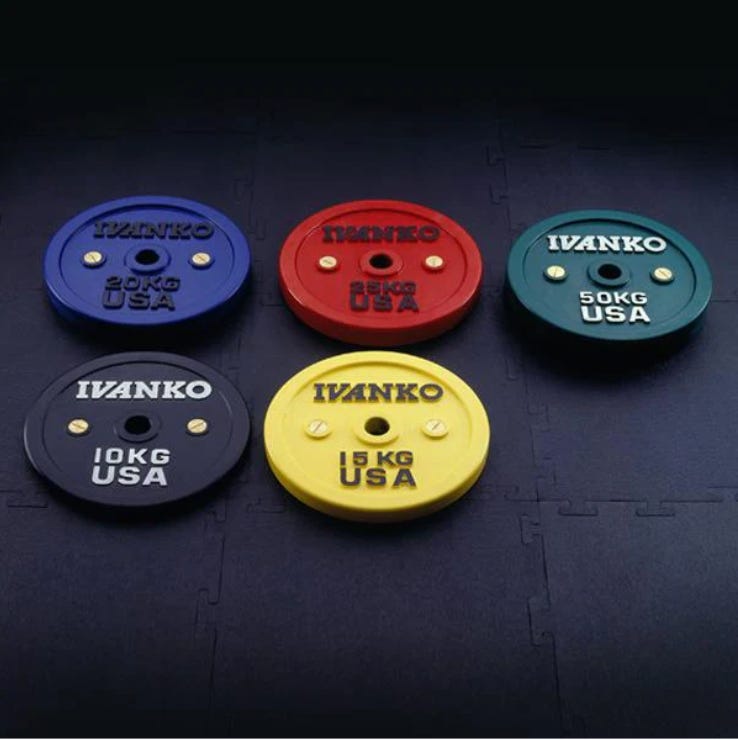
Calibration plugs on competition plates
Digital Weights
So now that we have the rundown of how analog weightlifting machines work, let me talk about digital weight. The biggest name here is Tonal. Tonal was founded in 2018 by Aly Orady and their primary product is a ~$3k wall-mounted weightlifting platform that has two cables and allows you to do full-body routines from your house.

Lebron with a Tonal (I’m in)
But how does this work? How are they packing 200+ pounds of weights in that slim form factor? Well obviously they’re not and the engineering behind it is pretty interesting. The resistance engine inside the Tonal is an electric motor but instead of using electricity to spin something, the motor resists being spun. When you pull the cable, you back-drive the motor, and the controller commands torque that opposes you. Vary the current through the coils and you vary the resistance, which is why the system can deliver smooth, precise weight in single pound increments and why Tonal can generate the equivalent of around 260 pounds of gravity-based resistance while replicating most machines in a weight room. The maximum digital resistance is 250 pounds on Tonal 2 and 200 pounds on the original Tonal.
Sensors (encoders measuring cable position and speed, plus current sensing in the motor) feed a processor that continuously computes how a real mass would behave at that instant: how much force gravity would apply, plus or minus the force needed to accelerate or decelerate the simulated mass, and then commands the motor to produce exactly that tension.
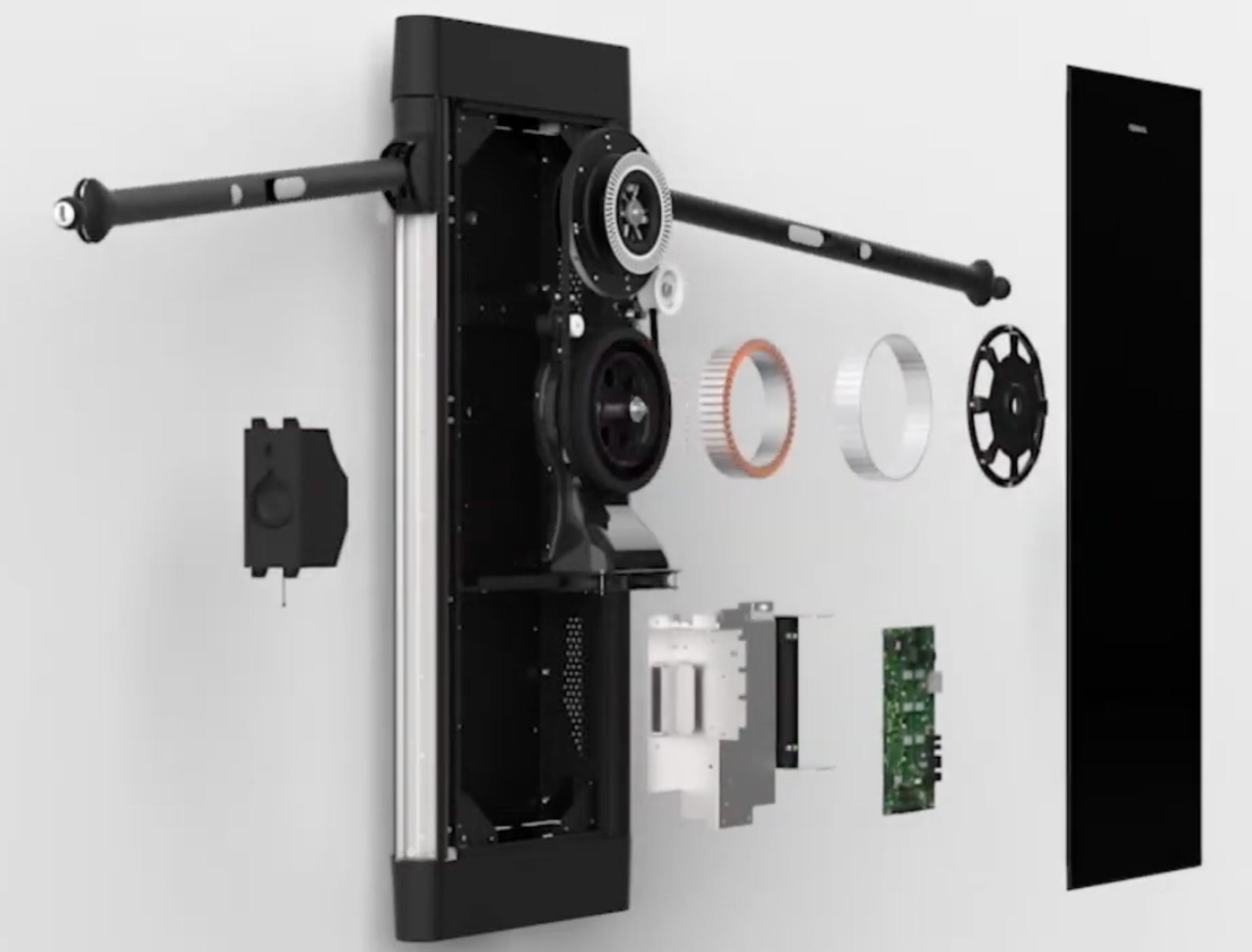
There’s also some fun stuff if you look at the patent for Tonal like the inertia-matching from the motor. At low simulated weights, where the motor and linkage’s own inertia would exceed the inertia of the simulated weight, the processor applies a positive compensation factor that subtracts out the machine’s mechanical inertia as a function of acceleration. As simulated weight increases past the point where machine inertia equals simulated inertia, the compensation flips negative, and the motor adds torque proportional to acceleration to simulate the heavier weight stack’s inertia. The same patent notes that friction compensation is deliberately partial, around 60 percent, because compensating for all friction can make the control loop unstable and cause vibration. Basically to put it simply, the motor will help you while the weight you’ve selected has inertia less than the inertia of all the internal components and oppose you once the weight you’ve selected exceeds that inertia.
I think where a lot of folks see value in Tonal is the idea of variable weight while you’re in the middle of a rep. The machine can add load on the eccentric phase or act as a spotter by reducing weight when you struggle, plus assisted unracking, where the machine detects the cable’s state, determines whether you’re ready to accept load, and only then applies resistance. This is all likely an output of the encoder.
How does calibration of the Tonal work? Well there’s likely two parts.
Motor calibration. Assume that this works the same as normal brushless DC motor calibration.
Mapping the cable tension to motor current. This is done by characterizing the motor for angular displacement versus applied load across a range of drive currents, so a torque or force value can be looked up.
Calibration is a one time thing which is way better than weights that can degrade over time, but I feel like it’ll run into the same pitfalls of cable degradation that other machines do? And that will cause friction to enter the system that is not accounted for - I wonder how they’ll deal with that. I’m also curious what the cables are composed of - since I imagine servicing the guts of the machine that it feeds into is more difficult than your traditional cable machine.
Also you might ask how this is different from the resistance on a Peloton? Peloton uses a passive magnetic brake. Permanent magnets are moved closer to or farther from a spinning aluminum flywheel. Aluminum isn’t normally attracted to magnets, but as the disk spins, free electrons inside it get pushed around by the passing magnetic field and circulate as eddy currents, and those currents generate their own opposing magnetic fields that try to slow the disk. Resistance is controlled simply by adjusting the magnet distance: closer means more resistance, farther means less. So actually the magnet can only resist you unlike the Tonal, and there’s no real computation involved, just sliding magnets.
Either way, super interesting idea and cool to see some new innovation in a space where the machines have looked the same for the last couple decades. I don’t have $3k to drop to really stress test the Tonal out though so I think I’ll stick to my local gym with the crappy welds for now (unless Tonal wants to sponsor us… reach out to hardwareishard@gmail.com if so).