
🚦 On your left (hand)... 💍
What goes into making a fitness wearable device?

🦸 Guest Writer: Madhav!
This week’s newsletter is a special edition written by Madhav Bhat based on an interview with Ultrahuman! Madhav graduated from the University of Michigan with his BSE and MSE May of 2024. Throughout his recruiting journey he interviewed for mechanical engineering internships and full-time positions with companies from large Fortune 500 corporations (think Ford, Michelin, Apple) to growth-stage companies (think Tesla, SpaceX, Anduril) to startups ranging from 3-1000 people in size working on all sorts of projects. If you have contacts in the wearables or humanoid spaces he can talk with please reach out to hardwareishard@gmail.com!
⚙️ Mechanical Engineering Resources:
We have put a dozen guides for mechanical engineering students and early professionals on our website
50 Hardware Startups who have raised less than $50 million (perfect internship targets)
How to handle The Behavioral Interview
What it takes to be The 10X Intern
What goes into making a fitness wearable?
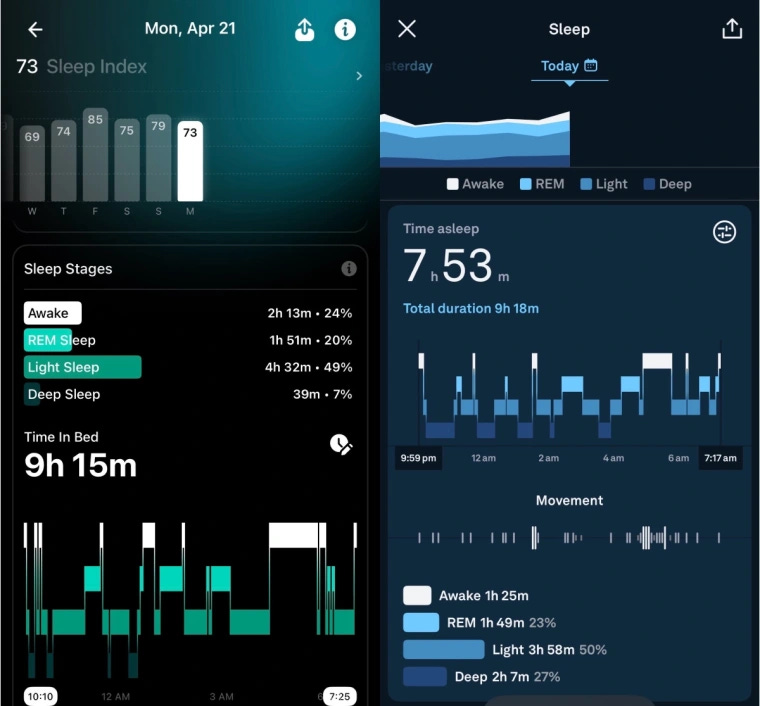
Recently (and especially in San Francisco), I’ve been noticing more bulky rings on people’s fingers and faceless watch straps on people’s hands. People have become more interested in rigorously tracking health metrics and there are a couple companies capitalizing on that with devices in the fitness wearables market. These devices track health metrics like sleep, HRV, and steps as well as custom metrics like “body battery” or a “recovery score”.
As someone who’s tried these products before, it begs the question, how are we packing so much power into such a small form factor that has to go through some of the most rigorous everyday usage a device can go through? We decided to explore that in these week’s newsletter through some research, as well as talk with some experts like Ultrahuman Ring’s head of mechanical engineering - Mainak Mitra.
What actually makes up these devices?
Exterior
For this section, we’ll focus specifically on fitness-tracking rings (which I find super interesting) and start from the outside in. For the portion of the ring that faces outwards from the finger, these can be made from other materials, but primarily are made out of titanium since the important element here is a strong stiffness to weight ratio. You’ll see this theme of weight-saving pop-up many times (normal ring jewelry is ~3g, Ultrahuman has gotten their rings down to 2.5-4g). In addition to the titanium on the outside, there are various coatings that are used on the ring’s exterior for scratch resistance. This can include:
Tungsten carbide carbon (WCC) coating - 2x as strong as steel but also 2x as dense
DLC (Diamond-like-carbon) coating - very hard but also very sleek (pretty cool)
I could not find a great source for how the titanium exterior is constructed but can assume it’s either metal injection-molded or CNC machined.
On the outside of the ring that faces into the finger, there is either:
a medical-grade epoxy resin that covers the otherwise exposed circuitry. This is what was on previous Oura ring generations and the Ultrahuman ring
also titanium. In later Oura ring generations there is a titanium inner cover with holes for the sensors.
Interior
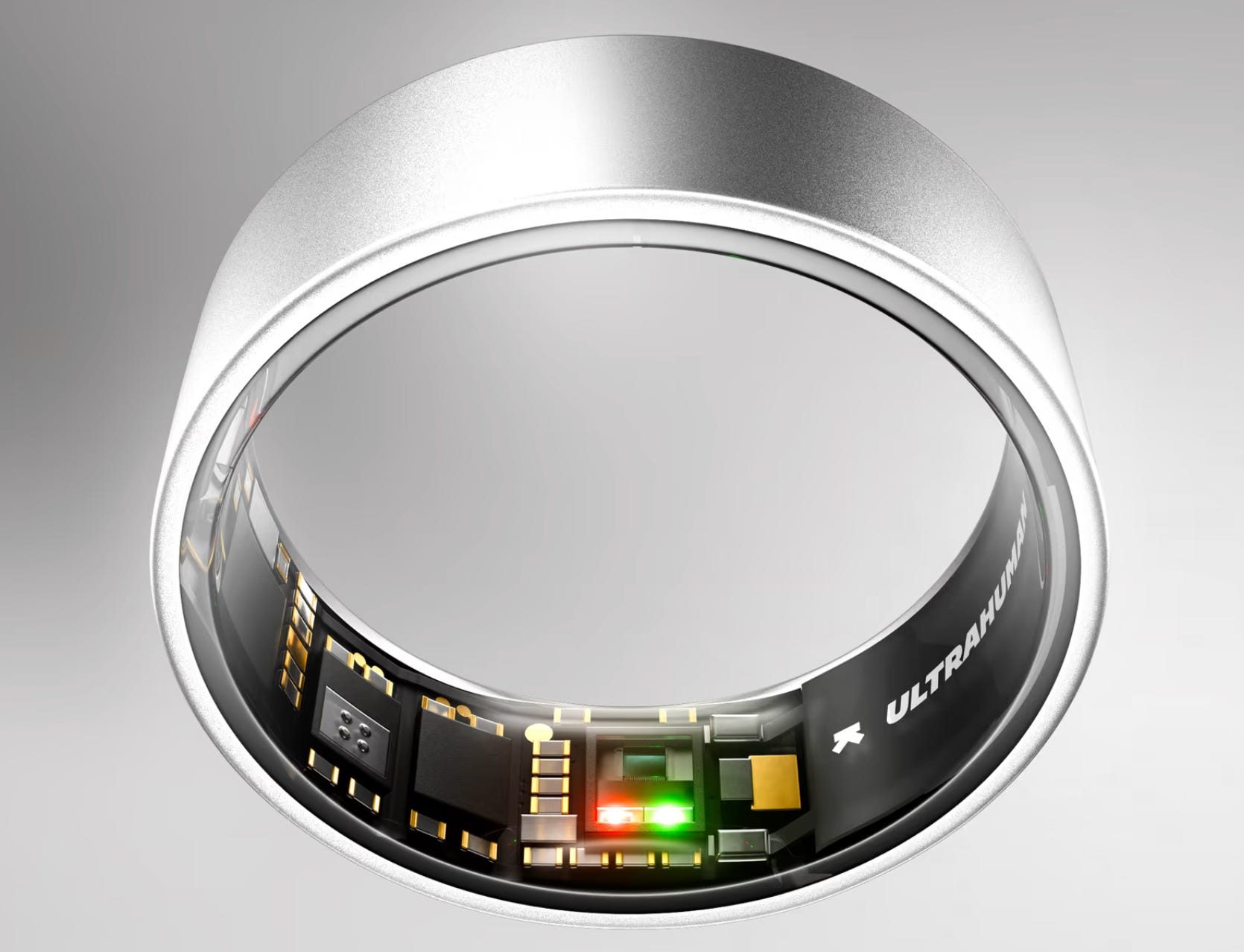
On the inside we have the sensor suite and core hardware which can reliably consist of a couple key components:
Optical Heart Rate / PPG (Photoplethysmography) Sensor - this is primarily for heart rate and oxygen monitoring
Temperature Sensor - this is to track baseline skin temperature
Inertial Measurement Unit (IMU) — 6-Axis Motion Sensor - this is how the ring monitors if you are moving or standing still
BLE radio - used for communication from and to device
Inductive charging coil - used to charge the device. This is extremely unique in that it is a custom curved battery that serves as a major constraint and space-consumer in the ring.
These components are placed on a flexible PCB made of polyamide that’s curved into a J-shape before being inserted into the ring. You don’t see deliberately curved PCBs too often!
Once the PCB is made and sensors are in place, adhesive is used to mount it to the titanium shell and resin is poured over the assembly to finish out the creation of the ring (and also support in holding all the components in place). One interesting fact is that the resin requires a 24-hour cure time which is a production bottleneck.
Testing
One thing I wanted to dive deep on is how do you test something that’s constantly in contact with other surfaces all day and cannot deform?
Like other consumer electronics, the rings go through hardness and abrasion testing, as well as significant drop testing.
They also go through accelerated life-cycle tests with thermal loading. One thing Mainak pointed out that was an interesting edge-case was that “biohackers” often take their rings from the Sauna, directly into a cold plunge, so going from 150 deg F to 30 deg F in a matter of seconds, and they might be doing this every day, so the ring needs to go through rigorous thermal cycling tests to capture this!
Because the ring sits on your finger, it needs to go through a Cytotoxicity test as well to evaluate the general toxicity of the device/material in compliance with ISO 10993.
And finally one of the biggest factor of designing a fitness wearable is answering “is this comfortable??”. Ultrahuman tests rings amongst a wide range of demographics with different skin color and thickness to ensure comfort and sensor performance. These users need to cover 95% of the population.
Interesting properties
In a ring form factor, the mechanical engineer is in charge. The ring needs to be a certain dimension out of concern for comfort for the user, and this in turn defines a lot of the electrical hardware choices (ex. how large of a battery can we use?) for the ring.
Also in this small form factor, tolerance stack-up plays a huge role and there can’t be compromises. This is why Ultrahuman (and Oura I believe) manufacture most components in-house - take a deeper look in this article by Android Central! Components like flexible PCBs and curved batteries make the manufacturing process pretty bespoke and unique.
In fact, if you look into the article above, the entire manufacturing process is pretty hands-on and arduous(although this article is about a year old). Components are soldered onto PCBs by hand, resin takes 24 hours to cure and even after that needs to be polished and refined to make sure it’s comfortable on skin. Scaling is one of the most difficult aspects of designing a new product that requires meticulous detail on a very small scale.
Conclusion
What makes smart rings fascinating from an engineering perspective is that they sit at an intersection that doesn’t really exist anywhere else in consumer electronics. You need jewelry-level craftsmanship — titanium forming, surface coatings, comfort testing across thousands of finger shapes — combined with the sensor integration and firmware work of a proper electronic device.
However, once again, we are still in the infancy of this technology. Even a device as small as a ring has gone through many iterations of design and features since they were first launched in 2015. The parts are still bespoke, the tolerances are razor thin, and a huge chunk of the engineering comes down to “does this feel okay on someone’s finger all day.” It’s a weird, cool intersection of craft and tech — and it’s still very much being figured out with active advances on both the hardware and software side. Excited to see what comes next!
Great insights into the wearables space!